In shortNo. Balloons flew on 223 days in Cappadocia in 2025, so roughly 140 dates had no commercial flying at all, while 754,098 passengers went up on the mornings that worked. The Slot Service Centre publishes a red, yellow or green flag per sector for each dated window, and a passenger flight needs wind at or below 10 knots.
223 daysflyable days in 2025
140 dayswith no flying at all
10 knotsmaximum wind for passengers
from $126classic balloon morning
Do hot air balloons in Cappadocia fly every day?
No, and the gap is wider than most itineraries allow for. Balloons went up on 223 days in 2025, and 754,098 people flew on those mornings, which leaves roughly 140 dates in the year with no commercial flying over the valleys at all.
The official framing is not much more generous. The government describes terrain and climate as allowing flights on up to 250 days a year, and the regulator's own count for 2018 came to 230 flight days and 30,514 flights. Nothing about the fleet explains the shortfall: 367 balloons, 585 licensed pilots and 30 firms stand ready in the region, which hosts about 80 percent of all hot-air balloon excursions in Türkiye. What removes a date from the calendar is the air over the launch fields. Even the most generous official count leaves over a hundred dates off the calendar.
Demand therefore piles onto fewer mornings than your calendar shows. Published advice is 2 to 4 weeks ahead between April and November, June to August months in advance, winter about a week. One morning in Göreme is a bet on roughly six chances in ten.
The classic morning, booked for day one
With roughly four mornings in ten unflyable, put the full 3.5-hour morning from $126 on your first available dawn: hotel pickup and drop-off, snack breakfast, champagne ceremony and flight medal, 5.0 ★ (8535 reviews), with free cancellation up to 24 hours before.
★ 5.0/5 · 8,535 reviews
The Cappadocia balloon flag system, in plain language
Each dated flight window gets its own published decision from the Slot Service Centre, written out as a specific date and time block: 17.10.2026 from 03:20 to 15:05, for instance. Each sector of the designated LTB1 (Kapadokya) area is flagged separately. LTB1 is split into Sectors A, B and C plus secondary flight Regions 1 to 5, and the authorised area at Nevşehir Çat receives a determination of its own, so two launch areas can get different answers for the same dawn.
Red and yellow come to the same thing for a paying passenger: your flight has no departure clearance. Only instructor-led training flights may proceed, and then only after the crew has contacted SHGM officials. Red means the conditions were judged unsuitable for flight within that stated block of hours.
Green is clearance to use the window. The pilot and the operator still make the final call on whether to launch, at the field, on the conditions in front of them. Behind the paperwork sit three accredited organisations at Kapadokya University's hot-air-balloon research centre, which handle slot allocation, pilot training approval and airworthiness management, while the area itself is administered by Kapadokya Alan Başkanlığı in Nevşehir.
| Flag for your sector | What it means for a passenger flight |
|---|
| Red | Conditions judged unsuitable for the stated window; no departure clearance for commercial flights. Only instructor-led training flights, after contacting SHGM officials. |
|---|
| Yellow | Also no departure clearance for commercial flights in that window; the same training-flight exception applies. |
|---|
| Green | Clearance exists for the window, but the launch call still belongs to the pilot and the operator. |
|---|
What actually stops the balloons
Wind at ground level is the hard number. Commercial passenger flights may only operate when wind speed is at or below 10 knots, and that ceiling applies to every basket size and every price tier on the same morning. Clear sky with 12 knots across the field means no launch.
Temperature is the second constraint and it pushes the other way. The flight area sits at 1,224 m above sea level, which sets an upper air-temperature limit of about 15°C for a loaded passenger basket. That is why the whole operation lives in the window that opens 30 minutes before sunrise and closes at 11:00, ahead of the ground heating that generates thermals later in the morning.
March and April are the weakest months, which catches out people who booked spring deliberately. Kapadokya University's meteorological assessment of the flight area names both as months with relatively high wind speeds and the least favourable for ballooning. Precipitation follows a similar curve: rainy days average about 13.1 in March and 12.3 in January, against 1.7 in August. Treat "April to October" as a loose season rather than insurance, and expect to lose mornings in early spring.
How a no-fly morning actually plays out
The first signal usually arrives the evening before. Exact pickup times are not fixed when you book; they are confirmed once the next morning's flight plan is set, and that is also the point at which the published decision for the coming window becomes worth reading. If the flag for your sector is red, the call comes that evening, so the alarm never goes on.
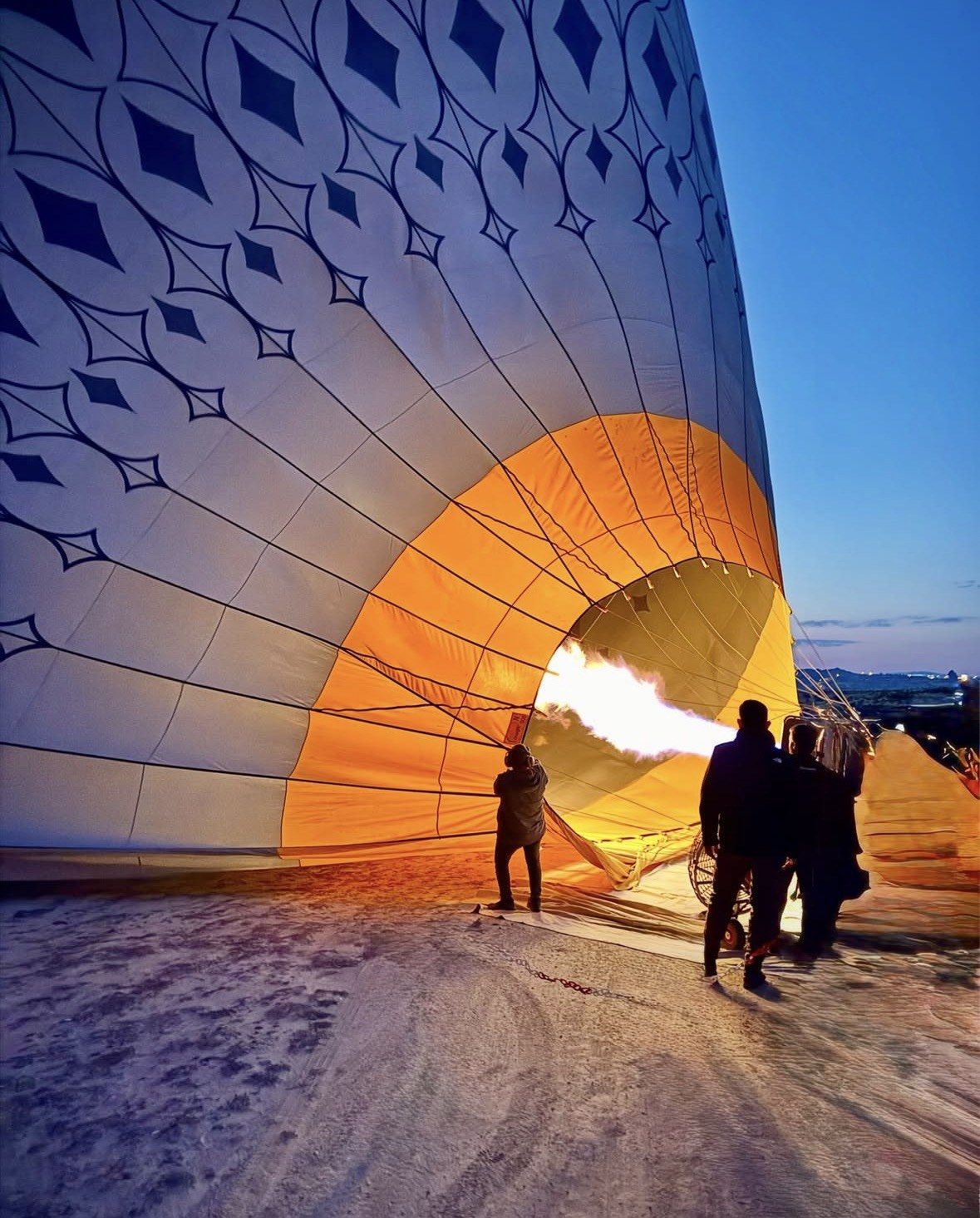
Sometimes it goes further. Under a green flag the minivan comes, the envelopes come off the trailers, and the launch is still a judgement made at the field on the conditions there. Crews stand down after pickup more often than you would guess.
From there it is a question of calendar space. The remedy is a later morning inside your stay, and that only exists if you left one free. Read the terms attached to whatever you book before you pay, and keep at least one spare dawn behind the first attempt.
How many nights to book, and which morning to fly
Three nights in Göreme is the minimum that makes sense when roughly four mornings in ten are unflyable, and the balloon belongs on the first full one. Mornings two and three then work as reserves, and a red flag costs you nothing worse than a lie-in and a slower breakfast. Book the flight for your last morning instead and one unsuitable window ends the trip without a flight.
An afternoon slot is not a sensible backup. On paper there is a window from 14:00 until 30 minutes after sunset, weather permitting. The capacity analysis shows it cleared for use on 28 days across the whole of 2019, with just 26 percent of those slots taken. The meteorological assessment treats afternoon flying as unsafe in most months, with November, December, January and partly October the exceptions, so a winter visit is the only case worth asking about.
For the flight itself, the choice comes down to this:
- One dawn available and no wish to economise on it: the 3.5-hour classic morning, from $126, 5.0 ★ (8535 reviews), covering hotel pickup and drop-off in an air-conditioned minivan, snack breakfast, live commentary in the basket, a flight medal and the champagne ceremony once you are back on the ground.
- Tight budget on a short stay: the 3-hour sunrise flight, from $90, 5.0 ★ (3361 reviews), which covers snacks, an air-conditioned vehicle and a flight certificate.
- A grounded morning to refill: the Red (North) Tour, 6-7 hours from $33, 5.0 ★ (2277 reviews), with hotel pickup and drop-off, a professional guide, lunch and all fees and taxes; or the Green (South) Tour, 7-9 hours from $33, 5.0 ★ (2653 reviews), with admission and entrance fees, lunch and an air-conditioned vehicle.
- An evening to use instead: the Sunset ATV Quad Tour, 2 hours from $40, 4.9 ★ (1447 reviews), over Love Valley and Rose Valley with briefing, guide and helmets.
- Arriving from Istanbul with two days: the all-inclusive trip from $687, 4.9 ★ (482 reviews), with flights, transfers, boutique hotel, breakfast, lunch, skip-the-line museum tickets and a licensed guide; the balloon flight is not included and has to be specified in the special requests when booking.
Questions people ask
Which months have the best and worst odds of flying?
The regulator's 2018 season breakdown is the only official month ranking available, and it put October top for flight volume and January bottom. March and April carry the highest wind speeds in Kapadokya University's assessment of the flight area, which makes clearance least dependable in those two months. September and October are the steadier bet.
Does one decision cover the whole of Cappadocia?
No. The designated LTB1 (Kapadokya) area is divided into Sectors A, B and C plus secondary flight Regions 1 to 5, and each gets its own daily fly or no-fly determination. The authorised area at Nevşehir Çat is managed alongside it with a separate decision of its own.
Does rain cancel a Cappadocia balloon flight?
Precipitation is part of the meteorological picture behind the published decision, but the figure that decides a commercial passenger flight is wind: at or below 10 knots. Rainy days average about 13.1 in March and 12.3 in January, dropping to 1.7 in August and 2.3 in July, which is one reason late summer and early autumn mornings run more reliably.
How far ahead should I book if so many days are lost?
Published advice is 2 to 4 weeks ahead in the high season of April to November, with June to August filling months in advance and winter usually needing around a week. Because only 223 of 365 days were flyable in 2025, the same number of passengers competes for fewer mornings than the dates suggest.
Can I fly in the afternoon if the morning does not go?
Rarely, and it is not worth planning around. A second window is written into the rules, 14:00 until 30 minutes after sunset when the weather allows, yet across 2019 it opened on 28 dates in total and those slots ran at 26 percent occupancy. Outside November, December, January and part of October, the official assessment does not regard afternoon conditions as safe for flying.
Read also