In shortDress in everyday clothes in layers, with closed flat walking or sports shoes that grip. Dawn at Göreme is the coldest hour of the day: average lows run 5.1°C in April, 13.7°C in July and −3.6°C in January, and the field sits at 1,224 m. Add gloves, a beanie and thermal layers from December to February, tie long hair back, and skip sandals, heels and loose scarves.
5.1°CApril dawn average low
13.7°CJuly dawn average low
−3.6°CJanuary dawn average low
1,224 melevation of the flight area
How to dress for the launch field and the basket
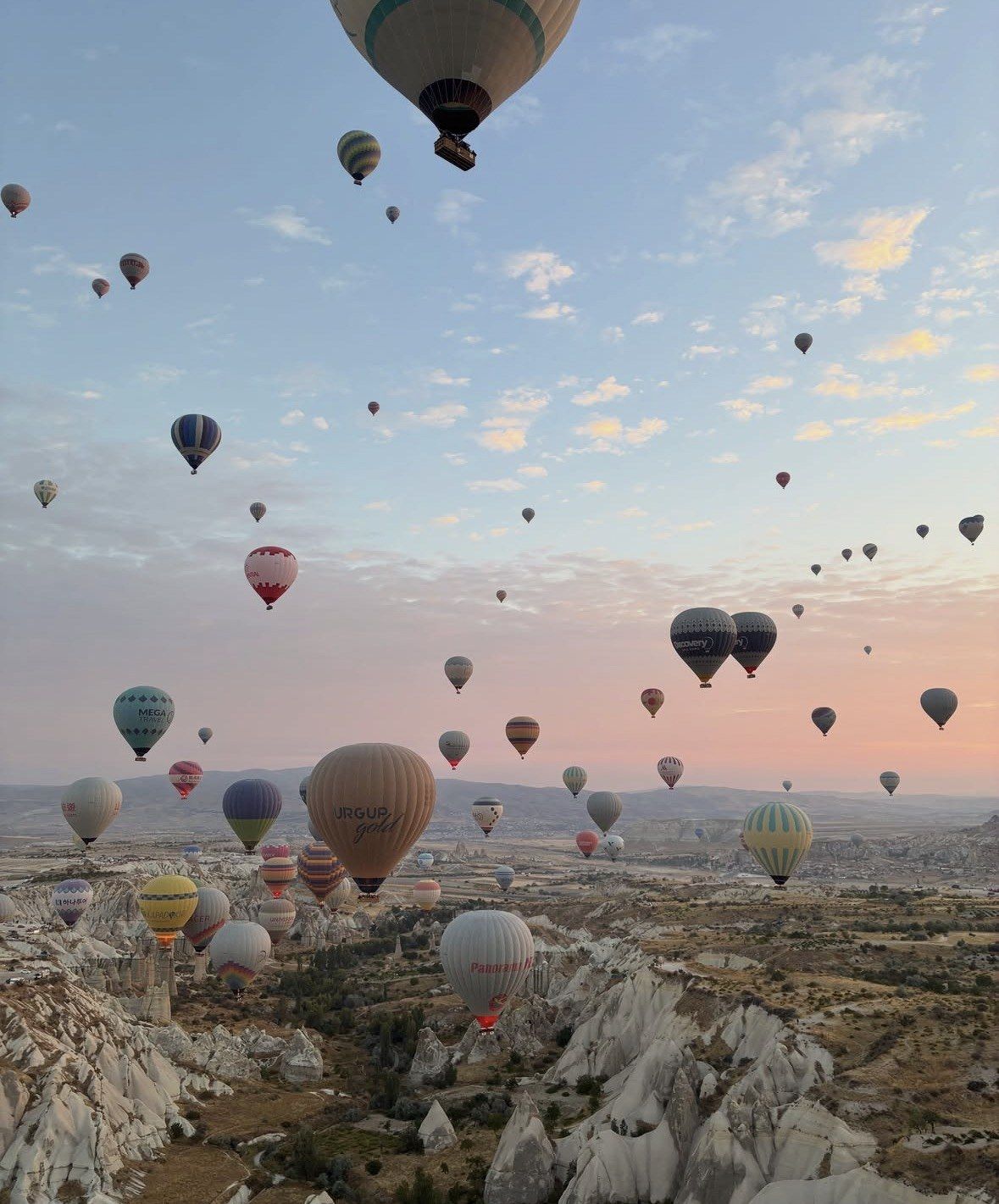
Two mistakes account for almost every uncomfortable morning here. The first is dressing for the daytime weather you experienced yesterday instead of for the half hour you spend standing on a dark field while the envelope fills. At the Nevşehir station the average daily minimum is 13.7°C in July and 13.6°C in August, roughly 15°C below the afternoon maximum of 28.5°C and 28.7°C, and the flight area sits at 1,224 m, which is why even an August dawn needs a sweatshirt.
The second mistake is footwear. The briefings operators read out ask for closed walking or sports shoes with flat soles and grip, and they discourage sandals, slippers, high heels and anything loose. That is not about style. What you wear has to survive a climb over the basket wall made unaided, the whole flight spent on your feet, and a braced landing position held for about five minutes, which the briefings compare to sitting on a horse.
Once you are airborne the cold eases off. You travel with the wind rather than through it, and the burners above your head throw out real radiant heat, which is why taller passengers are advised to wear a hat. Build the outfit so you can shed a layer in the basket and put it back on for the drive home.
The dawn temperature you are dressing for
Your layers should come from the dawn average for the month you are flying in. Spring and autumn want trousers, long sleeves and a jacket; summer wants light trousers and a sweatshirt; winter wants a heavy coat with thermal underwear and two pairs of socks under it. May is the wettest month at 57.9 mm and March averages about 13.1 rainy days, so a shell you can pull over the lot earns its place in the suitcase in both shoulder seasons.
Winter is a different exercise. January's mean temperature is −0.1°C with an average maximum of only 4.0°C, and the dawn minima average −3.6°C in January, −2.6°C in February and −1.3°C in December. Gloves are the item people skip and then regret, because you will be holding a camera or a basket rail with bare hands in that air.
| When you fly | Average dawn low | What to wear |
|---|
| July and August | 13.7°C and 13.6°C | Light trousers plus a sweatshirt over a t-shirt; August averages 1.7 rainy days |
|---|
| April | 5.1°C | Trousers, long sleeves and a jacket; add a thin fleece under it |
|---|
| May | 8.9°C | Trousers, long sleeves, a jacket and a shell; wettest month at 57.9 mm |
|---|
| September | 10.5°C | Trousers, long sleeves and a light jacket |
|---|
| October | 6.8°C | Trousers, long sleeves and a proper jacket, gloves if you feel the cold |
|---|
| December, January, February | −1.3°C, −3.6°C, −2.6°C | Thermal underwear and two pairs of socks under a heavy coat, with a beanie, scarf and gloves |
|---|
Shoes for a hot air balloon in Cappadocia
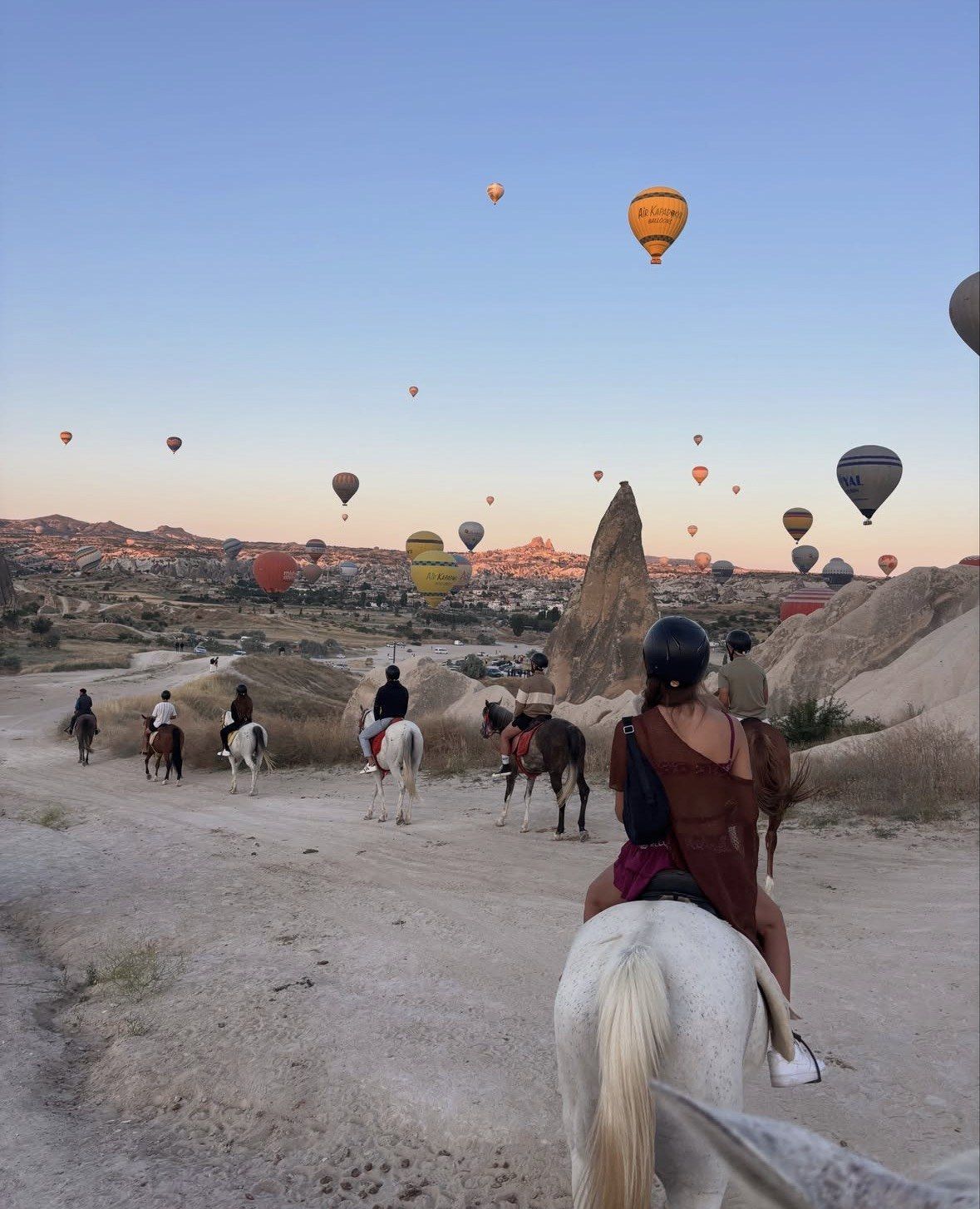
Closed, flat, laced shoes with a grippy sole. Trainers or walking shoes are exactly right, and the Göreme briefings say so plainly while asking passengers to avoid open footwear and high heels. The launch fields are dirt and stubble, often damp at that hour, and you walk across them in the dark.
Landing is the part people underestimate. The pilot chooses the landing area on the morning itself from the wind, so it may be a field with uneven ground, and you take the impact standing with your knees soft and both hands on the rail. Sandals slide, heels sink, and flip-flops leave you nothing to brace with. If your trip is otherwise a sandals-only packing list, this is the one morning to carry a second pair.
Socks matter more than they sound. Two pairs in winter is standard advice from the briefings, and in any month closed shoes with socks beat bare feet in canvas shoes on a field that has been sitting under a clear night sky.
Wear the layers on the sunrise flight, from $90
Once the layers and the closed flat shoes are packed, this is the flight to use them on: 3 hours from hotel door to hotel door, from $90, with snacks, an air-conditioned vehicle and a flight certificate, rated 5.0 ★ (3361 reviews).
★ 5.0/5 · 3,361 reviews
Hair, hats and keeping your hands free
Tie long hair back before you leave the hotel. The burners fire in bursts directly above the basket and they radiate heat downward, which is also the reason taller passengers are told to wear a hat. Make it a close-fitting one. The same briefings ask you to leave loose items behind, so a scarf you have to keep catching, a wide brim or a hood that lifts in the wind all work against you.
Carry a camera or phone on a strap around your neck or wrist, and nothing in your hands. You need both hands free for climbing in, for the burner bursts and for the landing position, and there is no shelf in a basket divided into compartments. Pockets with zips are the only sensible storage. Spare batteries go in an inside pocket, since the air you are flying in is close to the daily minimum and cold shortens a battery fast.
Leave at the hotel, or in the vehicle:
- Sandals, slippers, flip-flops and heels of any height
- Loose scarves, floppy hats and anything that flaps
- Handbags, shoulder bags and tote bags you have to hold
- Tripods and selfie sticks, which have nowhere to go in a compartment
- Formal clothes and anything you would mind getting dusty on a dirt field
Lay everything out the night before
The pickup happens in the dark and you will be dressing half awake. Göreme's sunrise shifts across the year: about 05:15 at the June solstice, 06:03 in mid-April, 06:48 in mid-October and 07:53 at the December solstice, the latest of the year, with collection from your hotel coming roughly 60 to 90 minutes ahead of it, earlier the further your bed sits from the launch field. A June pickup therefore lands near 04:15. The precise minute reaches you only the evening before, once the next morning's flight plan is set, so the clothes should already be ready when that message arrives.
That is the moment to put the whole outfit on a chair: shoes with socks inside them, trousers, two tops, jacket, hat, gloves if it is winter, hair tie on top of the pile and the camera already on its strap. Anything you have to look for in the dark is something you will leave behind.
Put the flight on the first full morning you have in Göreme. Only 223 days produced commercial flying in Cappadocia in 2025, which leaves roughly four mornings in ten with no balloons at all; clearance is decided sector by sector for each dated window inside the designated LTB1 (Kapadokya) area, a red or yellow flag means no commercial departure is cleared, and under green the launch call still sits with the pilot and the operator. Keeping your later mornings free is what turns a grounded dawn into a lie-in rather than a loss.
Questions people ask
Is there a dress code for a Cappadocia balloon flight?
No formal dress code exists, and the briefings specifically ask for everyday, non-formal clothing in layers, preferably cotton. The only firm requirements are closed flat shoes and no loose items. Dress as you would for a cool early walk on a dirt track, because that is what the launch field is.
Can I wear a dress or a skirt in the basket?
Trousers are the practical choice. You climb over the basket wall to get in and out unaided, you stand for the whole flight, and you brace for the landing with your knees bent, none of which is comfortable in a skirt. Operator kit lists name trousers in every season, with light trousers in summer.
Do I need gloves in Cappadocia?
In December, January and February, yes. The average daily minimum at the Nevşehir station is −3.6°C in January, −2.6°C in February and −1.3°C in December, and you are outside at close to that figure. In October, with an average low of 6.8°C, bring them if you feel the cold; in July and August, with lows near 13.7°C, leave them behind.
Will I be too hot once the burners fire?
The burners radiate heat downward, which is why taller passengers are advised to wear a hat, but it is intermittent rather than constant. Layers solve it: open or remove the outer one in the basket, then put it back on for the ceremony and the drive back, which happens in the same cold air you left.
Do children need anything different?
The same closed flat shoes and the same layers, in sizes they can manage themselves, since every passenger has to climb in and out unaided and follow the safety briefing. The published minimums are about age 6 at most operators and five at one Göreme company, with a height check of roughly 1.20 to 1.40 m so the child can see over the basket rim.
Read also